
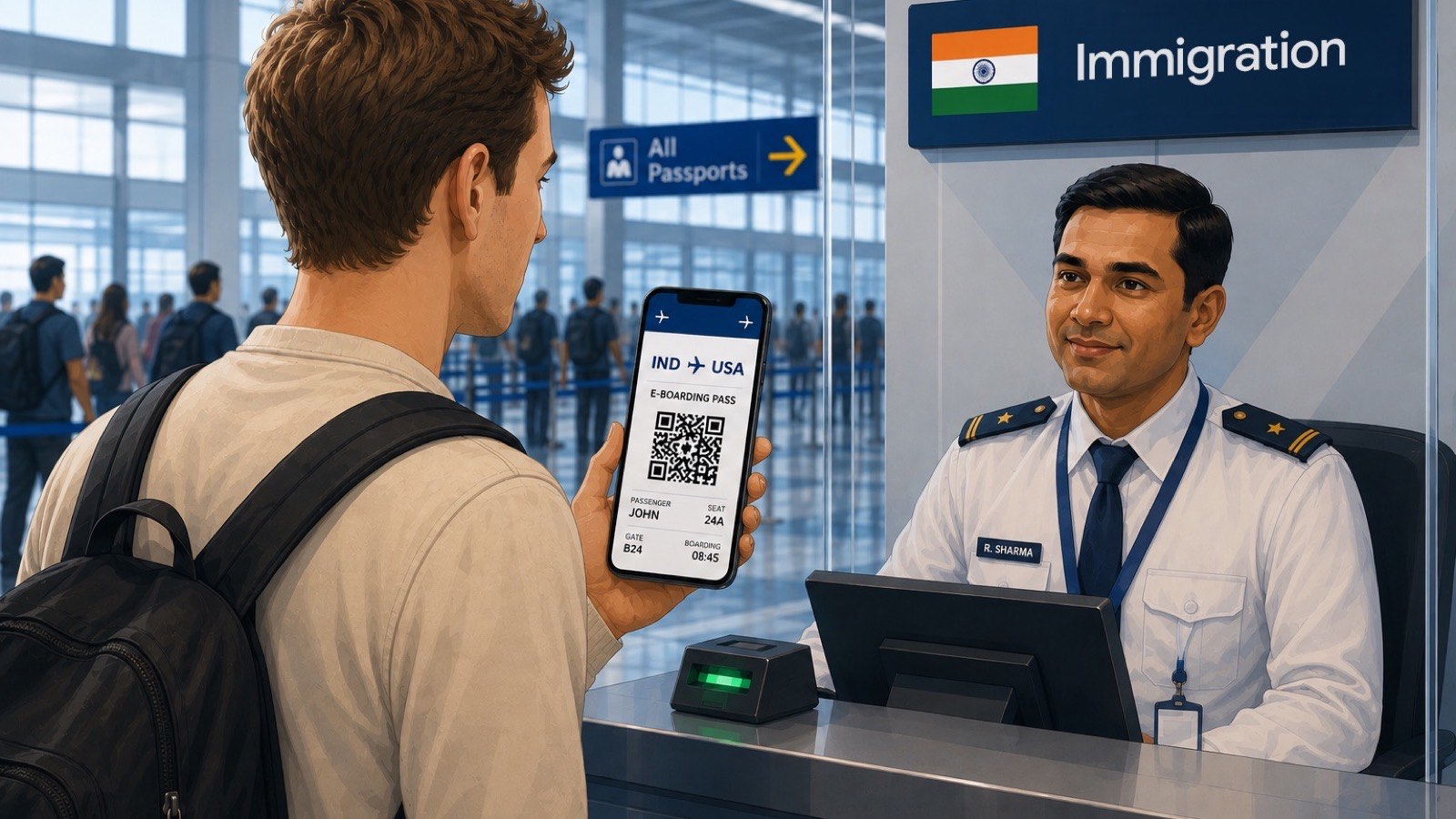
If you are flying abroad from India on or after September 1, 2026, one small familiar ritual is going away. The immigration officer will no longer stamp your boarding pass.
From that date, international passengers departing Indian airports can show an e-boarding pass on a smartphone for immigration clearance, and immigration counters will stop stamping physical boarding passes altogether. The change applies at every international airport in the country. It is a useful update and a modest one, and it does not touch your passport, your visa, your check-in or airport security.
What changes on September 1
The Bureau of Immigration, which works under the Ministry of Home Affairs, has issued a directive ending the practice from September 1, 2026. Officials quoted by PTI said the matter had been examined and it was decided to do away with the mandatory requirement of physical boarding passes and the stamping of boarding passes at immigration counters at all international airports in the country.
Two things change at once.
- You no longer need a physical boarding pass specifically for immigration. A digital boarding pass on your phone is enough.
- Immigration officers will stop stamping boarding passes, whether digital or printed.
Officials told PTI the stamping process was causing inconvenience to passengers, and that improper or unclear stamps sometimes made boarding pass details hard to read, which led to errors during clearance. Dropping the stamp addresses both. The directive has been communicated to airport operators, the CISF and other stakeholders so staff are briefed before it takes effect.
For context, this is the last place your boarding pass still collected ink. The CISF stopped stamping boarding passes at the security check years ago, after the aviation security regulator BCAS dispensed with security stamping in 2020. Immigration was the holdout, and that ends on September 1.
Can you use the boarding pass on your phone?
Yes. From September 1, an e-boarding pass on your smartphone is valid for immigration clearance when departing India on an international flight.
The process at the counter stays familiar. You present your passport, the officer completes your immigration check and records your departure, and you show your boarding pass on your phone when asked. The officer verifies it on screen instead of stamping a paper copy.
Your e-boarding pass is usually the one your airline issues after web check-in or at a self-service kiosk, delivered through the airline app, by email or by SMS.
Save the pass offline, as a screenshot or in your phone's wallet app, so you are not depending on airport Wi-Fi or mobile data at the counter.
One practical caution. On some international routes, certain airlines do not issue a final boarding pass through web check-in alone. They require document verification at the airport counter first, and until that is done you may hold only a check-in confirmation rather than a valid boarding pass. That is an airline rule, separate from this immigration change, and it varies by airline and destination. Check your airline's process for your specific route.
Paper boarding passes are not banned
Nothing dramatic happens to printed passes. They remain fully accepted. If you prefer paper, collect one at the check-in counter or kiosk as always and show it at immigration as before. The only difference is that the officer will not stamp it.
Do not claim, and do not believe posts claiming, that physical boarding passes are banned. They are not. The change makes paper optional for immigration purposes, not prohibited.
If you find paper easier to manage, or you are travelling with elderly family members who prefer physical documents, carry printed passes without hesitation. A printed pass is also a sensible backup if your phone battery dies or the screen is damaged.
You reach the immigration counter and your phone is dead. What happens?
Who this applies to
The directive covers international passengers departing from India, at all international airports in the country, from September 1, 2026. It applies regardless of your nationality or your airline, because immigration clearance at Indian airports is a government process rather than an airline one.
- It applies to departures. Arrival procedures in India are governed by separate rules, and foreign nationals arriving at some airports now use an e-arrival card system.
- Domestic flights are unaffected. Domestic passengers do not pass through immigration at all, and security stamping ended years ago.
- The rules of your destination country are unchanged. Your passport still gets its usual departure or transit endorsement, and some countries may have their own document expectations after you land. Only the boarding pass stamp is going.
Separately, officials have said a pilot project is planned to phase out the physical entry and exit stamps in passports for Indian passport holders, with wider rollout expected after the pilot. That is a different change, and a future one. It is not what takes effect on September 1.
What this update does not change
This is a paperwork simplification at one counter. Everything else about international travel from India stays exactly as it is.
| At the airport | From 1 September 2026 |
|---|---|
| Boarding pass at immigration | Shown on your phone or on paper. No longer stamped. |
| Physical boarding pass | Optional for immigration, and still fully accepted |
| Passport | Unchanged. Still required, still presented, still endorsed as usual. |
| Destination visa | Unchanged. Set by the country you are flying to. |
| Airline check-in | Unchanged. Baggage rules, deadlines and document verification are the airline's. |
| CISF security screening | Unchanged. You still show the pass, and it has not been stamped there for years. |
| Immigration questions and records | Unchanged. Officers can still ask questions and still record your departure. |
| Domestic flights | Unaffected. There is no immigration counter on a domestic journey. |
| Arrivals into India | Governed by separate rules, not by this directive. |
If a website or a forwarded message makes this sound like a sweeping overhaul of international travel rules, it is overstating things. One stamp is retiring. The rest of the journey is unchanged.
Before you leave for the airport
The new process asks very little of you, but a few small habits make it smooth.
Departure-day checklist
0 / 6 completedProgress is automatically saved in your browser.
The rest of the departure list
What to actually pack for a first flight out, item by item, with baggage rules and customs restrictions for the UK and the USA.
Frequently Asked Questions
Clear, accurate answers based on official guidelines and real mentorship experience.
The one-line version
Check in online, save your boarding pass to your phone before you leave home, keep the phone charged, and carry a printed copy if you want a backup. Show the pass on your phone or on paper, and clear immigration with your passport as usual. Nothing else about your journey changes: same passport rules, same visa rules, same check-in and security process.
Facts here were checked on 26 August 2026 against the Bureau of Immigration's official channels and PTI reporting. If you are flying in early September, follow the instructions of your airline and airport staff on the day, and check the BoI's official channels for any further advisories closer to your date.
Verified Official Sources
- Bureau of Immigration, Ministry of Home Affairs: official advisory on e-boarding passes, published 24 August 2026 on the channel the BoI website lists for official updates
- Bureau of Immigration, Ministry of Home Affairs: official website and News Centre
- Ministry of Home Affairs: Fast Track Immigration Trusted Traveller Programme (FTI-TTP) portal
- Government of India: e-Arrival Card portal for foreign nationals arriving in India